.png)

*** This instrumental piece has been chosen to complement the works on display, deepening the mood and enhancing the exhibition experience. Press play and let it guide your visit.
Lola Shepard is pleased to present EVERYWHERE, AT THE END OF TIME, a virtual two-person exhibition showcasing the elegiac yet quietly powerful architectural paintings of American artists ADALBERTO ORTIZ and WILLIAM RULLER. The artworks range from representational to abstract, including pieces that meld both approaches.
EVERYWHERE, AT THE END OF TIME brings together works that feature landscapes where buildings survive as shadows and the remnants of industry remain as haunting monuments. In his representational paintings, Adalberto Ortiz portrays solitary industrial buildings imbued with a melancholic quality, while his abstract works distill architectural details into formal compositions. William Ruller depicts the ruins of America’s post-industrial landscape with a Chernobyl-like atmosphere, combining figuration and abstraction to suggest both collapse and resilience.
Together, their works reflect on the uneasy relationship between humanity and the structures it leaves behind, where absence and presence coexist in stillness.

ADALBERTO ORTIZ

ADALBERTO ORTIZ creates paintings that span minimalist depictions of gritty, sparse industrial structures partially obscured in shadow, alongside abstract compositions that incorporate architectural elements. Employing simplified forms, flattened spatial arrangements, hard-edged lines, and a palette dominated by cool hues, Ortiz constructs a vision of the built environment marked by quiet mystery and understated tension.
Ortiz’s industrial building paintings emphasize shape and surface texture within simple, carefully arranged compositions. Created with acrylic on board or canvas, these edifices are treated as flat, abstract forms that suggest depth and distance through line, color, and shading.


Muted and cool tones dominate the works, occasionally punctuated by fluorescent accents that introduce a subtle, surreal quality. His extensive experience as a set designer for television studios and theatrical productions informs his work, providing a strong sense of composition and spatial balance.
Ortiz’s architectural works often bring to mind artists such as Giorgio de Chirico and Edward Hopper in their portrayal of somber, solitary buildings, where light and shadow create ambiguity and invite open-ended narrative interpretation.
For Ortiz, these paintings are fundamentally about color, line, and the abstraction of space, rather than literal depictions of any specific place.


In addition to his industrial building paintings, Ortiz creates abstract works that are loosely derived from his archive of set designs. Many of the geometric shapes, lines, and textures that appear in these paintings originate from the theatrical computer-modeled sets he created commercially during his career as a set designer. His process also involves taking digital photographs of objects or scenes that capture his interest and may serve as source material.


Using 3D software, he constructs initial compositions, manipulating elements by adding, rearranging, simplifying, or eliminating forms. These abstract arrangements often suggest emergent images or scenes, which he refines through iterative experimentation with color, value, and perspective. By exploring the model from multiple angles, Ortiz generates a range of compositional possibilities before translating them onto canvas.

Once the digital study is fully realized, Ortiz begins painting on canvas, replicating the work. The physical act of painting adds new dimensions, as accidental drips, brushstrokes, and layered textures enrich it in both tactile and visual ways. The abstract paintings are without a discernible focal point, allowing the eye to wander freely across the surface.


Ortiz explains: “I try to give my paintings multiple dimensions so that they reveal something new every time you look at them. They should work on different levels and communicate through both the intellect and the senses.”

UNDER MANHATTAN BRIDGE, 2013. Acrylic on canvas board, 20 x 16 in.
A CLOSER LOOK AT ADALBERTO ORTIZ'S ABSTRACT AND REPRESENTATIONAL ARCHITECTURAL PAINTINGS

WILLIAM RULLER

WILLIAM RULLER draws his imagery from the industrial landscape of his childhood hometown, Gloversville, New York. Serving as both subject and metaphor, the desolate silence of the abandoned mills and tanneries pervades his work. Once a thriving center of leather production, the town is now marked by derelict structures that endure as poignant reminders of modernity’s rise and fall.
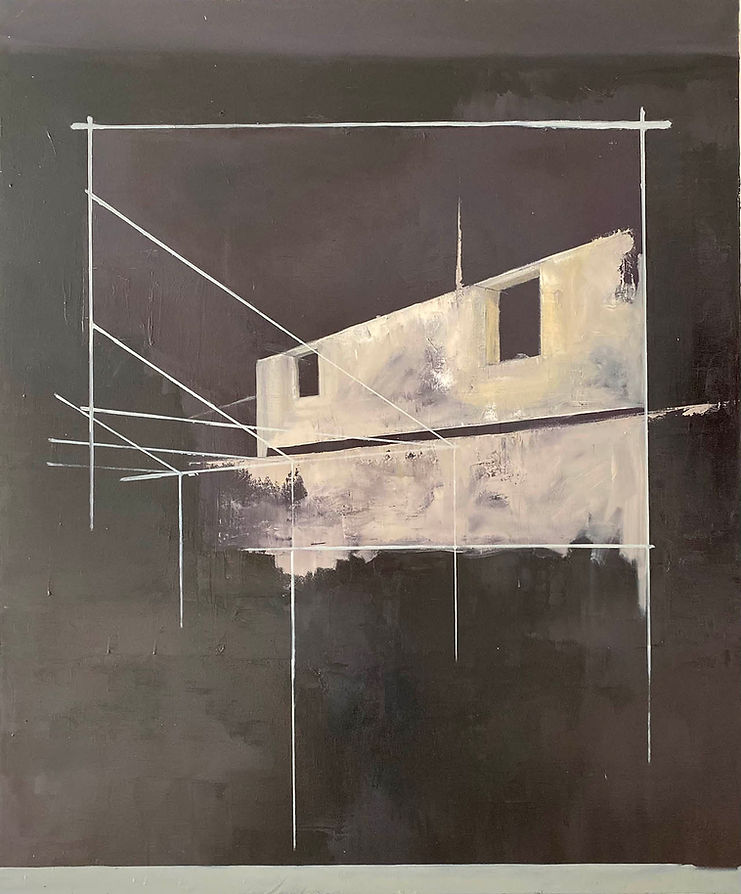


Balancing abstraction and representation, Ruller’s style recalls the alchemical surfaces of Warhol’s Oxidation Paintings. His canvases often stage a deliberate tension between solid blocks of color and fragments of architectural detail, forcing the two modes into uneasy coexistence. These “little battles,” as he describes them, push him beyond comfort and into continual cycles of destruction and rebuilding. To subvert the rules, he argues, one must first understand them.

BLEEKER STREET, 2022. Oil, paper, and clay on canvas, 39.37 x 31.5 in.


Accordingly, his practice shifts between gestural abstraction and what he wryly calls “self-aggrandizing phases” of painstaking detail, creating works that oscillate between fragmentation and clarity. Influenced by artists such as Anselm Kiefer, Mike Nelson, and Julian Schnabel, Ruller embraces risk and contradiction, testing aesthetic limits and compelling abstraction and figuration to collide.

His palette, drawn directly from these environments, speaks at once to entropy and endurance and the inevitable passage of time. Oxidized greens, faded blues, and seared reds, tempered by grays and blacks, anchor his palette, evoking the raw materiality of earth, clay, and concrete. Even when beginning with brighter hues, Ruller deliberately muddies them down, favoring the weathered quality of surfaces worn by time.


.jpg)
Recently, he has introduced solid blocks of brighter tones into his work, as in Untitled (Interior), which features stripes ranging from lavender to blue that disrupt the muted earth palette with raw, caustic contrast. In his hands, these colors become both memory and metaphor, recalling the toxic stains of polluted streams and chemical runoff while also conjuring the unsettling beauty of abandoned industrial landscapes.


Ruller reflects: “I liked that idea of the exact moment when things are about to completely disintegrate, but at the same time, everything is still there.”
At its core, Ruller’s work dwells on duality: the tragic beauty of decay, where disintegration becomes its own kind of presence. The result is work that feels both dystopian and deeply human, conjuring ghostly landscapes while offering new ways of seeing the aftermath of the industrial age.


.jpg)
ADALBERTO ORTIZ was born in Puerto Rico and is currently based in Latrobe, Pennsylvania. He earned his BA from the City University of New York and his MFA from New York University. Ortiz has exhibited widely in group and solo exhibitions across the United States, including the Southwestern Pennsylvania Council for the Arts, Westmoreland Art Nationals, Pittsburgh Center for the Arts, and the Westmoreland Museum of American Art. He has received numerous awards, including First Place Best of Show at the Southwestern Pennsylvania Council for the Arts and First Place at Westmoreland Art Nationals Juried Fine Art and Photography Exhibition, and has been honored with grants such as the Greater Pittsburgh Artist Opportunity Grant. In addition to his studio practice, Ortiz has worked extensively as a set designer for television studios and theatrical productions.
Born in Gloversville, NY, and now based in Apt, France, WILLIAM RULLER received his BA from SUNY Plattsburgh and his MFA from the Savannah College of Art and Design. He has exhibited widely across the United States and Europe, including museums, universities, and art centers, including the College of Southern Nevada (Las Vegas, NV), Delta State University (Cleveland, MS), CANO (Oneonta, NY), SCAD Lacoste (Lacoste, France), Tennessee Technological University (Cookeville, TN), Broward College (Davie, FL), Austin Art Connection (Austin, TX), Wausau Museum of Contemporary Art (Wausau, WI), Museo Palazzo Riso (Palermo, Sicily), Visual Arts Exchange (Raleigh, NC), Spartanburg Museum (Spartanburg, SC), Columbus State University (Columbus, GA), Peoria Art Guild (Peoria, IL), Maryland Federation of the Arts (Annapolis, MD), Barrett Art Center (Poughkeepsie, NY), Southwest University (Tucson, AZ), and Northern Arizona University Museum (Flagstaff, AZ). Ruller currently teaches at ACM/IAU (Aix-en-Provence, France) and has previously taught and lectured at the College of Charleston (SC), Savannah College of Art and Design (GA), and the Paris College of Art (France). His work has been featured in numerous publications, including N Magazine, Friend of the Artist, Whitewall, New American Paintings, Studio Visit, Dialogist, and Tulane Review.
